How to plan a backyard games afternoon in a small space
· Editorial team atlantanewsdaily7.com
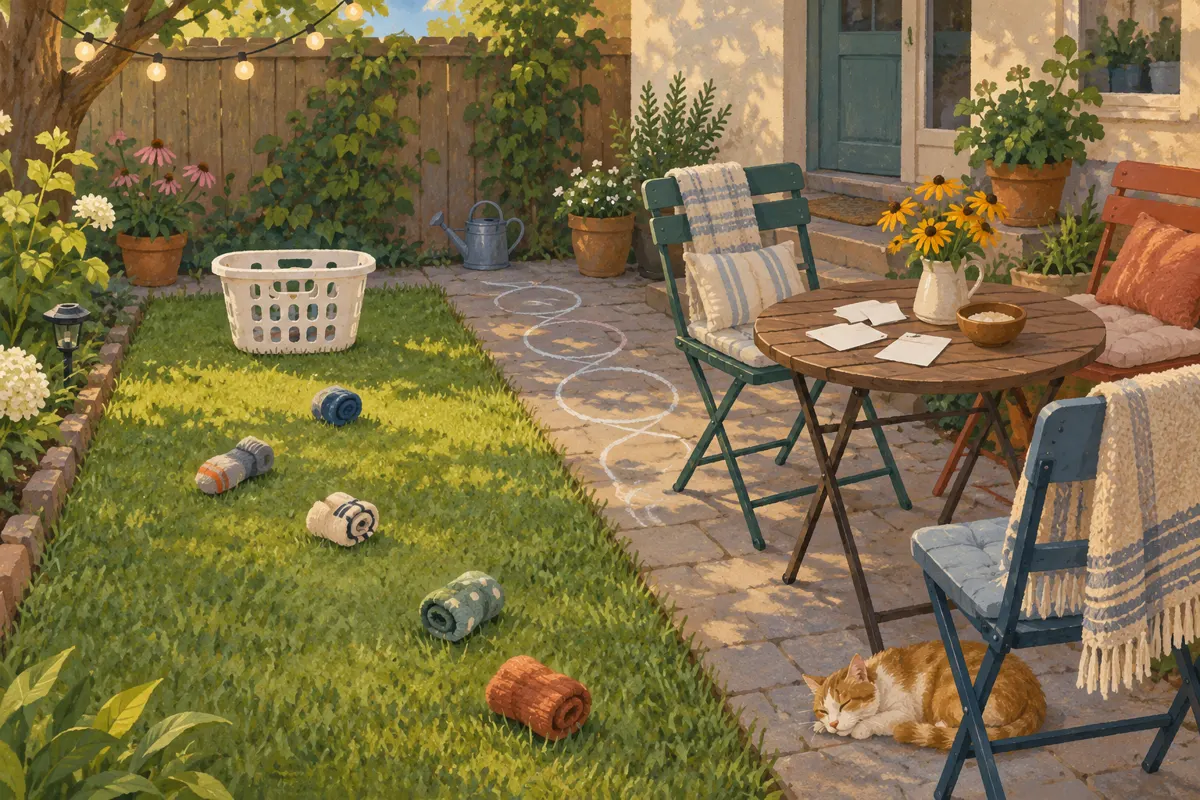
Organize a small-yard games afternoon around one clear throwing lane, one compact movement activity, and one seated game. Keep groups small, rotate them through short rounds, and let everyone choose how to participate. The proposed plan below uses household supplies and shared challenges, so adults and children can play together without a tournament.
Make room for play and a place to rest
Start by walking through the yard with chairs and tables in place. Identify a clear route from the door to the seating area, then see what space remains for games. Keep the throwing lane away from windows, the grill, snacks, and people passing through. Put waiting players beside the lane, beyond the throwing path.
If three stations would crowd that route, use one activity area and change its equipment between rounds. A seated game can stay available nearby. Choose level surfaces, leave room around chairs, and keep water and a shaded resting spot easy to reach.
- Rolled socks, a laundry basket, and a towel to mark the throwing line.
- Sidewalk chalk for a paved movement area.
- Paper, a thick marker, a bowl, and chairs for seated charades.
- A timer to keep rotations simple.
Set up three adaptable game stations
These station designs are editorial proposals inspired by target games, chalk courses, and charades. Explain each in one sentence, demonstrate a turn, and start with a practice round.
- Sock toss: Place a laundry basket at the end of the clear lane. Each player gently tosses three rolled socks toward it. Wait until all throws finish before collecting them. Choose a shared challenge, such as getting one sock into the basket per person, with no penalty for misses. Move the line or basket whenever someone wants a different distance.
- Chalk trail: On a clear paved patch, draw a short line, three circles, and a finish square. Players follow the line, pause at each circle to make a chosen gesture, then wave at the finish. Keep it walking pace and let one person use the trail at a time. A seated version uses a paper trail that players trace while the group copies their gestures.
- Seated charades: Write familiar actions on paper, such as stirring soup, brushing hair, or watering plants. Place the slips in a bowl. One player acts while everyone guesses together. Read prompts aloud when needed, allow a partner to help, and let anyone pass. For a quieter version, describe the action without saying its name.
Use a short rotation with generous breaks
Here is a proposed schedule for roughly an hour of organized play. Divide guests into three small groups, keeping children with an adult who can help. If space permits simultaneous stations, each group starts at a different activity and moves to the next when the timer sounds.
- First 10 minutes: Welcome guests, show the boundaries, and demonstrate all three games.
- Next 8 minutes: Play the first station, giving everyone a turn before repeating.
- Take 2 minutes: Gather equipment and move groups along the clear route.
- Repeat: Play two more 8-minute rounds, with a 2-minute changeover after each.
- Next 10 minutes: Pause for drinks, snacks, and conversation.
- Final 10 minutes: Revisit a favorite game or bring everyone together for charades.
For a yard with only one usable play area, run the activities sequentially for everyone. Leave charades available during waiting turns. End a round early if interest fades; the schedule is a guide, and guests can take longer breaks.
Let players choose their own level of challenge
Offer choices to the whole group instead of assigning easier rules by age. Someone may prefer a shorter toss, seated play, or extra thinking time. Ask what works for them before helping or moving equipment.
- Let players toss from a stable chair or place socks directly into a nearby basket.
- Offer gestures in place of stepping through the chalk trail.
- Explain rules aloud and demonstrate them; use large, clear writing for prompts.
- Keep turns flexible and skip countdowns during guessing games.
- Invite guests to choose prompts, encourage others, or simply watch.
- Celebrate shared attempts without rankings, elimination, or compulsory prizes.
Keep the afternoon easy to adjust
Before guests arrive, decide where the gathering can move if outdoor play becomes uncomfortable. Sock toss and charades can move to a cleared indoor area; the paper trail can replace chalk. Keep the doorway free during the change, collect loose equipment between activities, and finish whenever the group is ready for conversation. There is no need to fill every minute with another game.